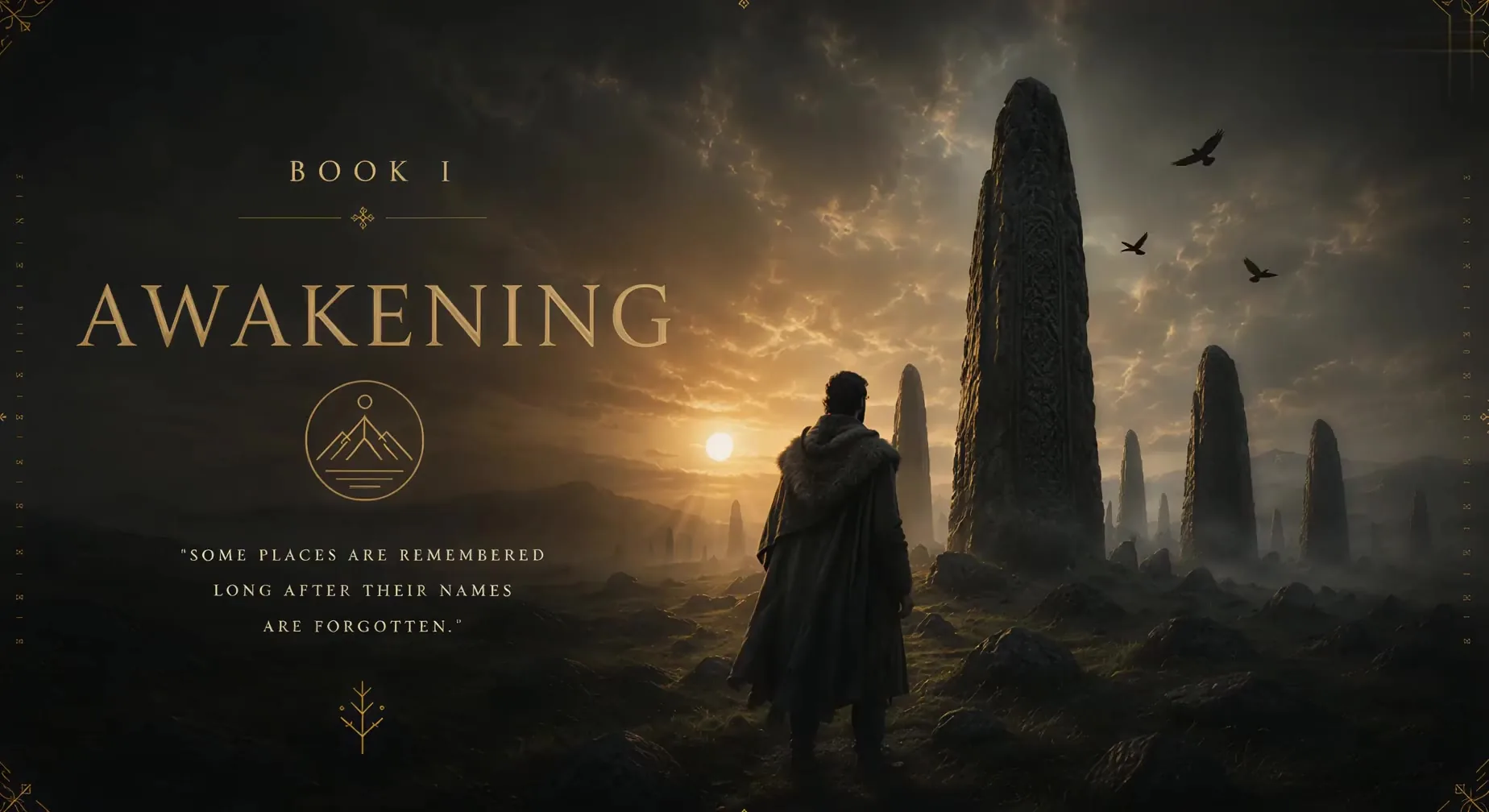
A cloaked traveller stands before rune-carved standing stones at sunset, beneath the title Awakening, Book I

The Forgotten Path Saga · Book I

Awakening: Book I of The Forgotten Path Saga, a historical fantasy by Hrafn Kjalunes

The saga begins. The legend awakens.

An epic trilogy inspired by the original Icelandic sagas.

In a remote valley where forgotten traditions still shape everyday life, an ordinary farmer discovers that the oldest legends were never meant to be remembered, they were meant to be obeyed.

About the Story

Some debts are older than memory

Iceland, a hundred and thirty years after the Landing. On Hrafnes, a raven-haunted headland of eleven households, people still keep customs nobody can explain: the first of every cup is poured onto the ground, the deep grass of one hollow is never mown, and a seat at the end of the bench is never sat in.

Einar Þorsteinsson is a carpenter who reads the world as load and grain, and he believes none of it. So when Snorri the Open-Handed, the district's charming and generous new chieftain, hires him to help pull down the ancient standing stone on the hill, Einar keeps his silence. The stone comes down.

Then the small wrongnesses begin. Milk sours in one house only. Ravens gather on the ridge, more each day. And a courteous stranger who pours out the first of every cup has come walking up the shore road, asking easy questions that all run one way.

To learn what his people have broken, Einar must walk east, across a haunted coast, toward the last keeper of a covenant the settlers forgot they ever swore.

“We don't cut the hollow.”
The custom of Oath-Hand's Stead
  • Custom without reason

    Old habits kept by rote long after anyone remembers why. Every poured cup and untouched field is a clause in something older.

  • The land as a character

    Basalt cliffs, black sands and breathing lava fields. Weather is the first omen, and the landscape keeps its own accounts.

  • Dread, and stubborn hope

    A slow-burning mystery in the spirit of the sagas: spare, grounded, and quietly uncanny, rising toward the epic.
The Characters

The people of the headland

A carpenter, his family, their neighbours, and the strangers who come up the shore road.

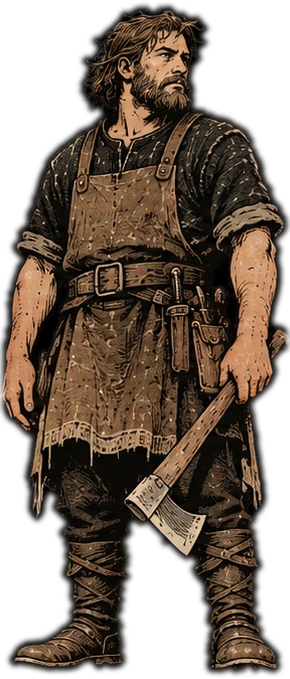
  • Einar, a bearded carpenter in a leather apron, an axe in his hand

    The Carpenter

    Einar Þorsteinsson

    28 · Oath-Hand's Stead

    The best carpenter west of the ford, and the man of his house since he was nineteen. Big-handed, deliberate, easier with timber than with talk. A skeptic who judges everything by touching it, wood, wall or weather.

    “He had from his father a thousand silences, and he needed every one.”
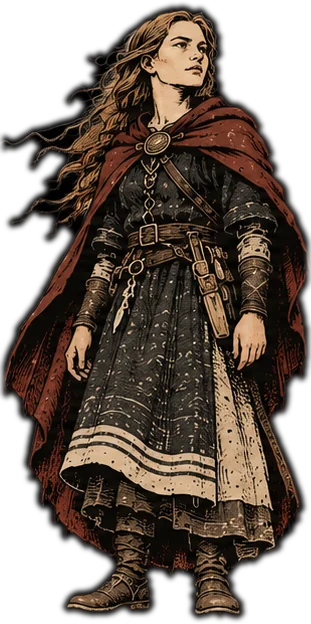
  • Ásta, a young woman with long windswept hair and a red cloak

    The Believer

    Ásta Þorsteinsdóttir

    17 · Einar's sister

    Quick, restless and unblinking. She argues like a lawspeaker and asks at doors everyone else walks past. Where her brother counts to keep a door shut, Ásta counts to open one.

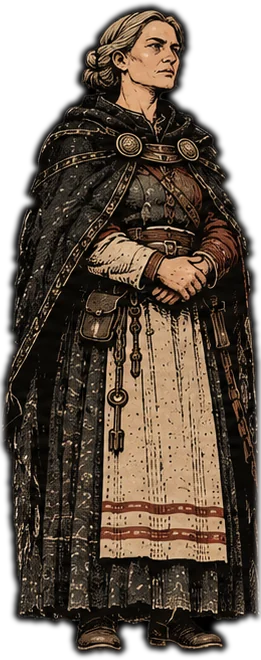
  • Sigríður, a stern woman in a dark cloak and pale apron, keys at her belt

    The Keeper of the Hearth

    Sigríður

    Mistress of Oath-Hand's Stead

    Widowed mother of Einar and Ásta, who keeps the household's customs with the old severity. Steel under wool: she ends an argument with a voice, not a reason.

    “We don't.”
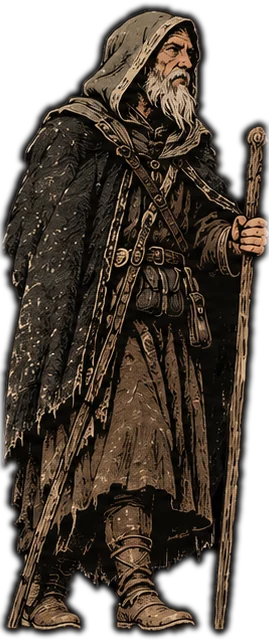
  • Skapti, a hooded, grey-bearded traveller leaning on a walking staff

    The Wanderer

    Skapti

    A stranger on the shore road

    A lean, grey-bearded traveller in a good cloak gone very far from good. He asks house-room in words too old and too correct, and pours out the first of every cup, exactly, always. He is easy to like.

    “Old roads keep old speech.”
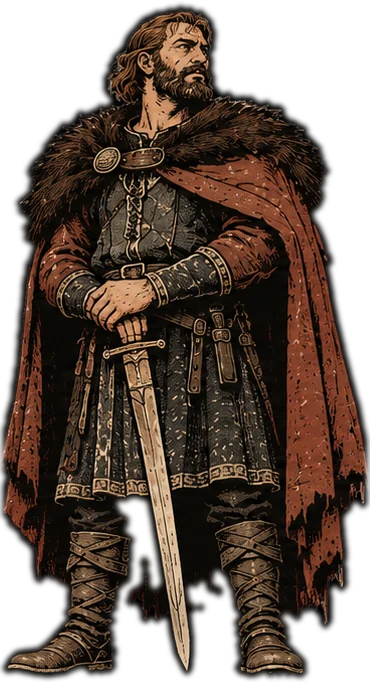
  • Snorri, a broad chieftain in a fur-collared red cloak, hands on a sword hilt

    The Open-Handed

    Snorri Auðunsson

    Chieftain of Stone Ford

    Warm, exact, generous, and lethal in argument. He pays on the day, knows every man's name, boat and debt, and mentions the debt exactly once. He is the most likable man in any room he enters, and he means it.

    “‘We don't’ is what want sounds like when it has given up asking.”
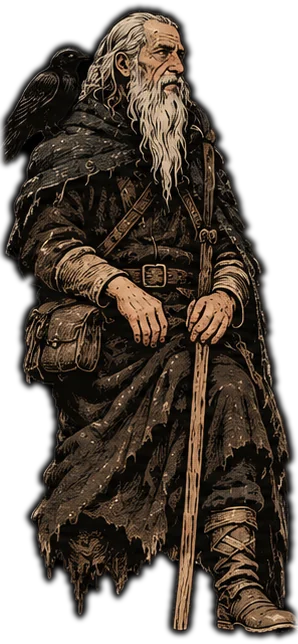
  • Gamli, a white-bearded old man with a stick and a raven on his shoulder

    The District's Memory

    Gamli Ravensfriend

    Eldest of Hrafnes

    A living archive of custom without reason, whose byname is so old nobody remembers the why of it. Dry, sharp, and fiercely territorial about news. He has his doubts about the stranger.

    “Bought hay eats twice.”
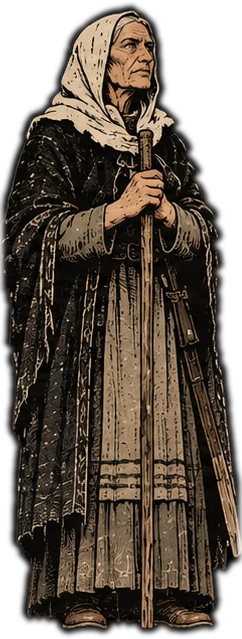
  • Rúna, an old woman in a pale headscarf holding a tall staff

    The Elder of the East

    Rúna Ketilsdóttir

    Far along the road

    In a valley that stays green when others wither, an old woman is said to remember what everyone else forgot. Small, straight and unhurried, she suffers neither fools nor chieftains, which she considers one category.

The World

An island that remembers

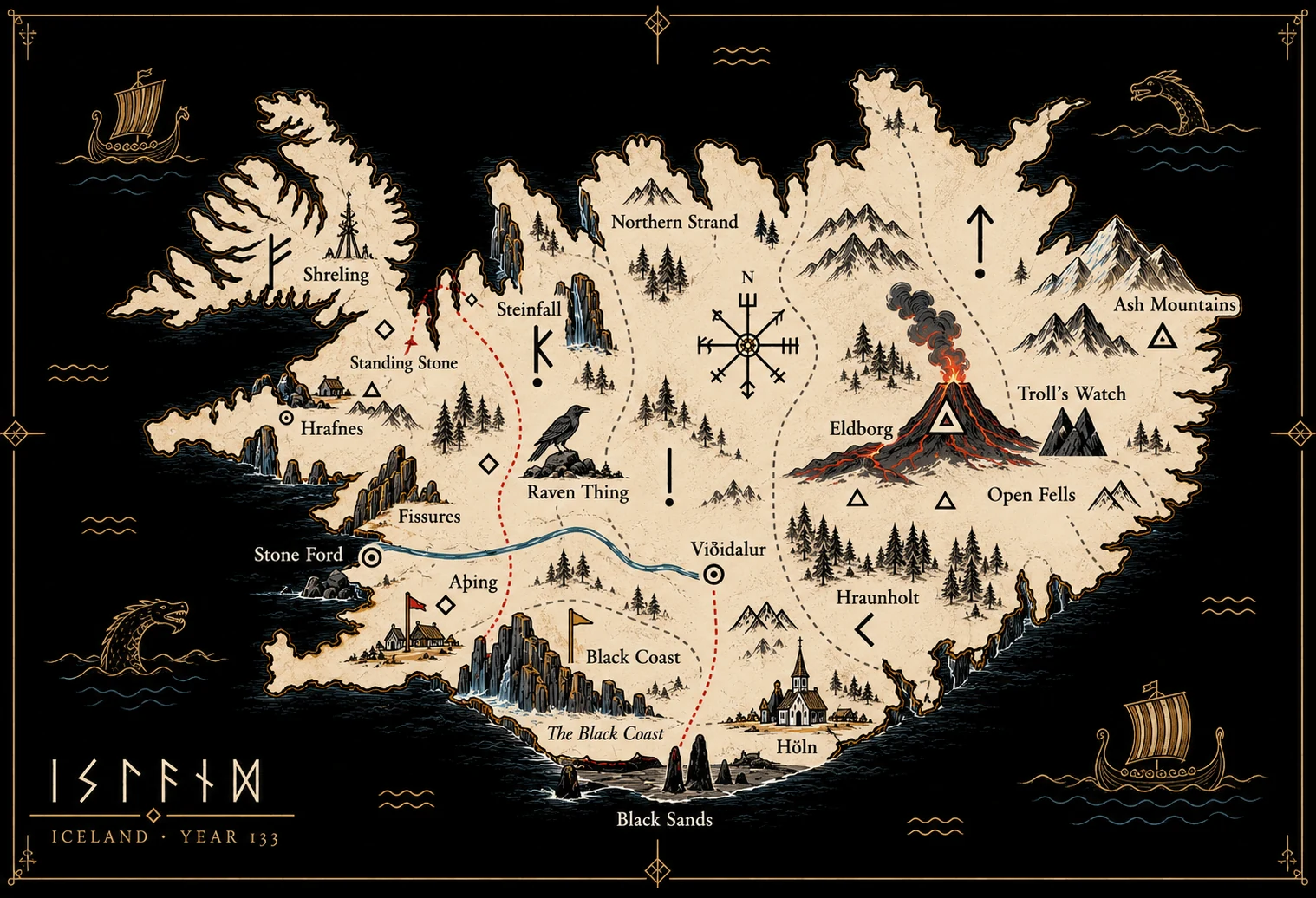
Iceland, one hundred and thirty-three years after the Landing. No kings, few roads, and a custom for every threshold. Select a glowing mark, or one of the runes that name the regions, to read what the district knows of it.

Illustrated map of Iceland in the year 133 after the Landing, marking Hrafnes, the Raven Thing, Viðidalur, the volcano Eldborg, the Troll's Watch and the other places of the story

Use + and − to zoom; drag or scroll to move around the map.

All places on the map

The Western Fjords

Steep fjord country at the island's north-west: narrow water, high walls, and farms that see the sun late. Hrafnes stands at its southern end, where the fjords give way to open coast.

A summer hut with turf walls and no roof: the roof went with the household that once grazed there. Walkers on the road north still use it for a night's shelter from the wind.

The Northwest

Hrafnes, Stone Ford and the farms between answer to the Raven Thing. There are no kings here and no king's men: power is custom, memory, law spoken aloud, and debt.

· Raven's Headland
Turf houses above dark basalt cliffs: eleven households, two six-oared boats held in common, and no chieftain. The first settlers' ships landed on the strand below, and the ravens that met them gave the place its name. Here stands Oath-Hand's Stead, the oldest farm in the district, its gate-posts cut by the founder's own axe.
A humped, dark hill at the valley's head. On its crown stands a lichened stone half again the height of a man, leaning a little south, with no carving at all. For nine generations it has been the district's bearing-mark on the skyline. On the good shelf below, Snorri is building a new steading.
Where the headland's grazing runs out, grass turns to moss, then to old lava cracks, knee-wide, then waist-wide, crooked as root-work. A path of cairns threads them to the last cairn. At dusk the dark rises out of the ground while the sky above still burns.
· The dead stead
A settlement half-buried in old lava flows, emptied in a single autumn seventy years ago. No bodies were found, and there was no burning. Lintels and doorways hold up nothing now. The district does not go there, and does not say why.
Three households' worth of driftwood shore, the timber thinner every year. In the fathers' day a man could gather a winter's timber here in a morning.
· Assembly of the northwest
Twice a year the district assembly gathers on the plain below the Sacred Barrow Hills, in sight of the ancestors' mounds, for suits, betrothals, hirings, and the year's reckoning. Law here is not written down. It is recited aloud, from memory.
A trading village at the northwest's only easy river crossing: a beach market, boat-sheds, a smithy working imported iron, and the chieftain's hall on the terrace above. New money lives here, and Snorri Auðunsson bought its chieftaincy outright.

The Frost Valleys

Climbing country of deep valleys, frost white on the rims and slow steam in the bottoms. The river that runs out of them reaches the sea at Stone Ford.

· Deepest of the Frost Valleys
Frost lies white as salt on the rims, yet the valley floor is green and threaded with slow steam. The stacks are fat, the beasts sleek, and the old customs are kept here openly. The Elder's House stands at the valley head, where the steams gather.

The Black Coast

A long south shore of black sand, sea-stacks and cave-mouths. No boat is drawn up anywhere along it, and no one has built so much as a drying-frame.

A coast of black sand running east out of sight. Sea-stacks stand out of the surf like the roof-posts of a drowned hall, and cave-mouths show and hide with the swell. Driftwood lies thick as a merchant's stock, and there is no sign of human work anywhere.
Tide-ribbed black sand between the last grass west and the first grass east, under a mist that never lifts. A toll-cairn stands halfway, every stone worn round by handling.
A whale-backed rise of grass and rock, well above the highest wrack. On its top is a ring of set stones older than anyone can read, around a fire-black hearth that every crossing has used.

The Lava Country

East of the green valleys the land gives out by degrees: grass to moss, moss to black lava, and steam standing up out of the ground in still air.

· The breathing lava
A day's width of cracked black lava under moss so deep it swallows light, with scores of steam-threads standing straight up in the still air. A cairned track runs along its southern hem, mended by no human hand anyone knows of.
· The fire-fort
A squat crater-mountain that has never quite gone to sleep. On still nights a red seam shows at its lip, snow never lies long on its shoulders, and its old flows run down toward Hraunholt like spilled pitch gone cold. Herders say the ground on its slopes is as thin as a pot-lid.
High, treeless grass and frost-heave under a hard east wind that leans on a traveller all day like a debt. Nothing breaks the skyline here but one black peak.

The Far East

Beyond the open fells, one lone black peak, and past it the Ash Mountains, where everything the western districts know about their own island runs out.

A single black peak, sharp-shouldered and alone, rising off the fells the way a post rises from a plain floor. Men say a giant is imprisoned there for its wickedness, and tell their children it eats them.
Far in the east, a country of ash and old fire that nobody from the western districts has walked. The map-makers of Hrafnes simply stop drawing here.

Elsewhere

· The great assembly
Every midsummer, chieftains, lawspeakers and litigants of last resort make the long ride to the island's great assembly. Few from Hrafnes have ever seen it. It is a name, and a place where bigger quarrels than theirs are settled.

The Trilogy

One forgotten oath. Three books.

The Forgotten Path Saga is told across three volumes: a historical fantasy rooted in settlement-era Iceland, in the spare voice of the original sagas. It follows one family, one district and one covenant from the day it is broken to the day it is answered for.

  1. Book I

    Awakening

    A stone falls on a quiet headland, and the land begins to keep count. The saga begins.

    Coming soon to Kickstarter

  2. Book II

    Title to be revealed

    The path, once found, has to be walked. What was begun in the east must be carried home.

    In development

  3. Book III

    Title to be revealed

    Every oath is answered in the end. The saga's close, and the covenant's reckoning.

    In development

Genre
Historical fantasy
Setting
Settlement-era Iceland
Inspired by
The Icelandic sagas
Tone
Dark, grounded, hopeful

Questions

About the book

What is Awakening about?

Awakening is set in Iceland a hundred and thirty years after the first settlers landed. Einar Þorsteinsson, a skeptical carpenter, keeps silent while the district's new chieftain pulls down an ancient standing stone. When strange things begin to happen, Einar must walk east along a haunted coast to learn what his people have broken.

Is Awakening a standalone novel or part of a series?

Awakening is Book I of The Forgotten Path Saga, a planned historical fantasy trilogy. Books II and III are in development.

What inspired the book?

The Icelandic sagas and the folklore of settlement-era Iceland: customs kept without reason, a landscape of black sand, lava and fjords, and the old belief that the land itself keeps accounts. The prose aims for the spare, understated voice of the sagas.

What kind of fantasy is it?

Grounded, dark historical fantasy. It is a slow-burning mystery that is quietly uncanny rather than full of spell-casting, rooted in real Norse and Icelandic history and customs, and hopeful against the odds.

When and where can I get Awakening?

Awakening is coming to Kickstarter. Follow the pre-launch page to be notified the moment the campaign goes live, and follow the saga on Instagram and TikTok for news.

The saga begins. The legend awakens.

Awakening is coming to Kickstarter. Follow the pre-launch page and be the first to know when Book I of The Forgotten Path Saga opens for backers.